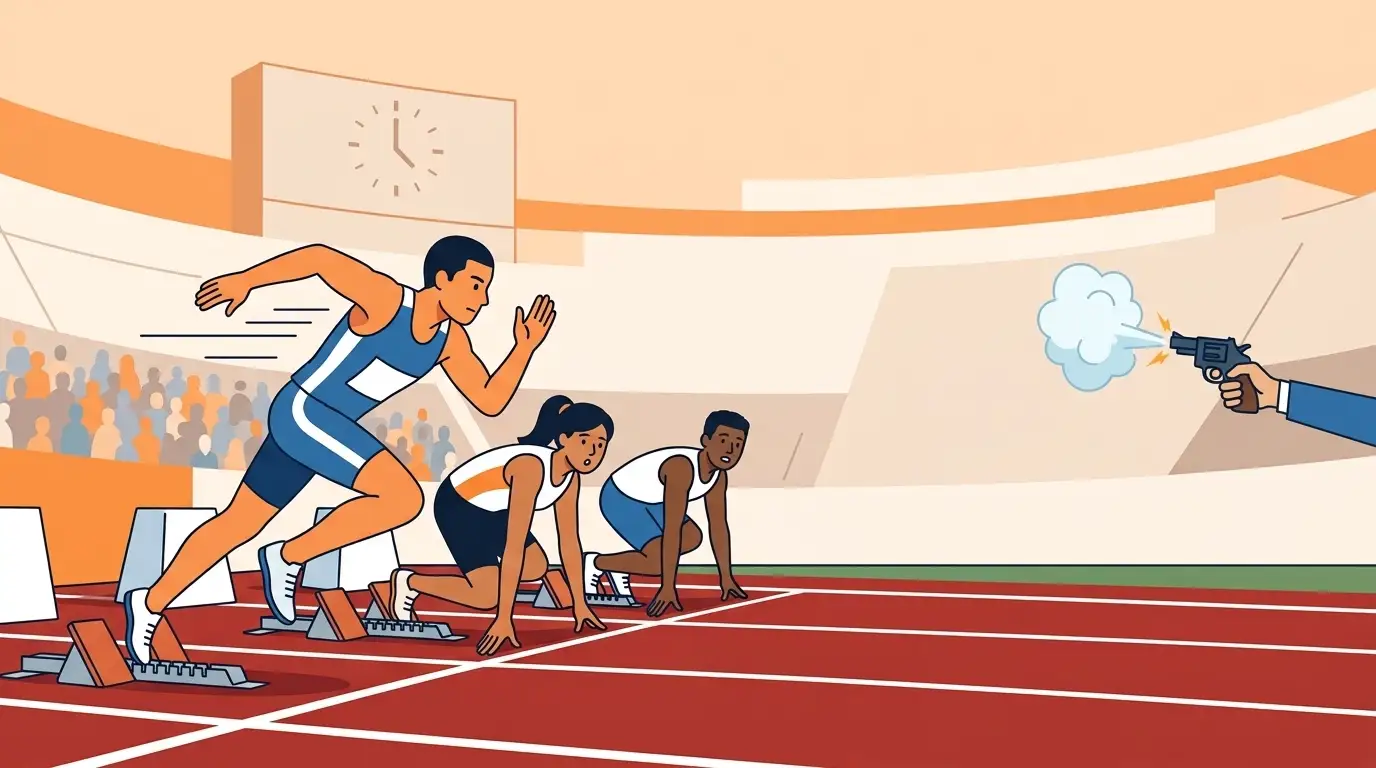
If you’ve ever heard someone say “don’t jump the gun,” you might wonder what guns have to do with anything. The jump the gun meaning is simple: it means to act too early, before the right time. People “jump the gun” when they start something before they should, often without enough information or before it’s actually time to begin.
This phrase shows up everywhere in sports, at work, in relationships, and in everyday chats with friends. Maybe your coworker announced a project was finished before it was actually done. Or your friend texted “congrats!” before you even got the job offer. That’s jumping the gun.
In this article, you’ll learn exactly what this phrase means, where it came from, how to use it correctly, and how it’s used in real life today. By the end, you’ll be able to use “jump the gun” the right way, every time.
Quick Answer
To jump the gun means to act too soon, start something before the proper time, or make a decision before you have all the facts. It’s usually seen as a mistake because acting too early can cause problems, confusion, or embarrassment. For example, if you start clapping before a speech ends, you’ve jumped the gun.
Meaning or Definition
The phrase “jump the gun” is an idiom, which means its meaning isn’t literal. Nobody is actually jumping over a gun. Instead, the phrase describes a specific kind of mistake: starting an action too early, usually before the correct signal or the right moment.
Here’s a simple way to think about it. Imagine a rule that says “wait for the signal.” If someone breaks that rule and starts early, they’ve jumped the gun. This can apply to:
- Making a decision before you have enough information
- Starting a task before it’s officially time to begin
- Announcing news before it’s confirmed
- Reacting to something before it fully happens
The phrase often carries a slightly negative tone. It suggests the person was too hasty, too eager, or careless. Nobody wants to be the person who jumped the gun and had to backtrack or apologize later.
It’s important to note that jumping the gun isn’t about being wrong on purpose. Usually, it’s about being too excited, too nervous, or too impatient to wait for the right moment.
Origin or History
The phrase “jump the gun” actually comes from track and field sports. In footraces, runners wait for a starting gun to fire before they take off. If a runner starts running before the gun fires, they have “jumped the gun.”
This kind of early start, sometimes called a “false start,” gives the runner an unfair advantage—if it’s not caught. Referees watch closely for this exact issue, because starting early breaks the rules of fair competition.
Over time, English speakers began using this phrase outside of sports. People started applying it to any situation where someone acted too soon, not just races. By the early 1900s, “jump the gun” had already moved into everyday language to describe general impatience or premature action.
This is a common pattern in English. Many idioms start in a specific setting, like sports or military life, and slowly spread into common conversation. “Jump the gun” is a great example of a sports term that became part of everyday speech.
Grammar or Correct Usage
Knowing how to use “jump the gun” correctly will help you sound natural when speaking or writing. Here are the basic rules.
Basic structure: The phrase is usually written as “jump the gun” or “jumped the gun,” depending on the tense you need.
- Present tense: “I don’t want to jump the gun.”
- Past tense: “She jumped the gun by telling everyone before it was official.”
- Future tense: “Try not to jump the gun on this decision.”
- Continuous tense: “He’s jumping the gun again with his predictions.”
Common sentence patterns:
| Pattern | Example |
|---|---|
| Jump the gun on (something) | “Let’s not jump the gun on this deal.” |
| Jump the gun by (doing something) | “They jumped the gun by launching early.” |
| Don’t jump the gun | “Don’t jump the gun—wait for the results first.” |
The phrase works as a verb phrase, and “gun” always stays singular. You won’t hear people say “jump the guns.” Also, this phrase is informal, so it fits better in casual conversation, emails between coworkers, or blog writing rather than very formal legal or academic documents.
Common Mistakes
Even though “jump the gun” is a popular phrase, people sometimes use it incorrectly. Here are a few mistakes to watch out for.
One common error is confusing it with similar-sounding phrases like “jump to conclusions.” While both involve acting too fast, they mean slightly different things. “Jump to conclusions” means making a judgment without enough evidence. “Jump the gun” means acting before the proper time, even if your info is correct.
Another mistake is using the wrong verb tense. Since “jump” is irregular in some contexts, people sometimes write “jumped the guns” or “jumping gun,” which are both incorrect. Stick to “jump the gun,” “jumps the gun,” or “jumped the gun.”
Some people also try to use this phrase too literally, thinking it must involve actual competition or racing. In reality, you can jump the gun on almost anything: a work project, a wedding announcement, a sports prediction, or even a simple decision about what to eat for dinner.
Lastly, be careful with tone. Since the phrase suggests a mistake, using it about someone in a harsh or mocking way can come across as rude. It’s usually better used in a light, friendly, or neutral way.
Real-Life Examples
Seeing this phrase in different situations can help you understand it better. Here are several examples from everyday life.
At work: “The marketing team jumped the gun and posted the announcement before the CEO approved it.” This shows the team acted before getting the proper green light.
In sports: “The sprinter was disqualified for jumping the gun during the 100-meter race.” This is the original, literal use of the phrase.
In relationships: “Don’t jump the gun and introduce him to your parents after just two dates.” This shows moving too fast in a personal relationship.
In shopping: “I jumped the gun and bought the shoes before checking if they had my size.” This shows making a purchase too quickly.
In news and media: “Some outlets jumped the gun and reported the election results too early.” This shows publishing information before it was confirmed.
In parenting: “She jumped the gun and signed her son up for the team before checking the schedule.” This shows a decision made without checking all the details first.
These examples show how flexible the phrase is. It fits nearly any situation involving timing and patience.
British vs American English
Good news here: “jump the gun” is used the same way in both British and American English. There’s no difference in spelling, meaning, or common usage between the two versions of English.
| Feature | American English | British English |
|---|---|---|
| Spelling | Jump the gun | Jump the gun |
| Meaning | Act too soon | Act too soon |
| Common use | Very common | Very common |
| Formality | Informal/casual | Informal/casual |
This phrase likely spread evenly across both dialects because it came from a shared sports tradition. Track and field events, including the rule about false starts, are followed and understood in both American and British culture. So no matter where your reader is from, this phrase will make sense.
Current Usage or Trends
Today, “jump the gun” remains a widely used idiom in spoken and written English. You’ll hear it in casual conversations, read it in news articles, and see it in social media posts.
It’s especially common in situations involving predictions, announcements, or decisions made under pressure. For example, during major events like product launches, elections, or sports championships, you’ll often see headlines or comments accusing someone of “jumping the gun” when they share information too early.
The phrase has also found a home in business and tech conversations. Startups get criticized for jumping the gun on product launches. Investors are warned not to jump the gun on buying stocks. Even social media influencers get called out for jumping the gun with unverified news.
Because it’s short, clear, and easy to understand, this idiom isn’t going away anytime soon. It fits naturally into modern digital communication, where speed and timing matter more than ever.
Tips or Best Practices
If you want to avoid jumping the gun in your own life, or you simply want to use the phrase correctly, here are some helpful tips.
First, always double-check timing before you act, speak, or publish something important. A short pause can prevent a lot of embarrassment.
Second, when writing, use “jump the gun” to add personality to your sentences, especially in blogs, emails, or casual writing. It’s more engaging than saying “acted too soon.”
Third, remember the tone of the phrase. It’s usually a gentle way to point out a mistake, not a harsh insult. Use it kindly when describing someone else’s early action.
Fourth, pair it with context. Simply saying “you jumped the gun” can sound vague. Adding a reason, like “you jumped the gun by replying before reading the full email,” makes your point clearer.
Finally, practice using it in different tenses and sentence structures so it becomes a natural part of your everyday vocabulary.
FAQs
What does “jump the gun” mean in simple words?
It means to act or start something too early, before the right time or before you have all the needed information.
Where does the phrase “jump the gun” come from?
It comes from track and field racing, where runners must wait for a starting gun. Starting before the gun is called jumping the gun.
Is “jump the gun” a formal or informal phrase?
It’s informal. It works well in casual conversations, blogs, and everyday writing, but it’s less common in formal legal or academic writing.
Can “jump the gun” be used in a positive way?
Usually not. It typically describes a mistake or a hasty action, so it carries a slightly negative or cautionary tone.
Is “jump the gun” the same as “jump to conclusions”?
No. “Jump to conclusions” means judging something without enough evidence. “Jump the gun” means acting before the correct time, regardless of evidence.
Do British and American English use this phrase differently?
No, both British and American English use “jump the gun” the same way, with the same spelling and meaning.
Conclusion
The jump the gun meaning comes down to one simple idea: acting too soon. If it happens in a race, at work, in relationships, or online, jumping the gun means skipping the proper timing and moving ahead before you should.
This idiom started with real starting guns in track races, but it has grown into a phrase we use in nearly every part of daily life. Understanding its meaning, grammar, and common uses will help you speak and write more naturally in English.
Next time you feel eager to act, remember this phrase. Take a breath, check your timing, and make sure you’re not about to jump the gun.

Hi, I’m Rubab, a content writer and meaning enthusiast with over 2 years of experience creating clear, engaging, and informative content about words, names, phrases, expressions, and their meanings. I focus on making complex or confusing meanings easy to understand through simple and reader-friendly explanations. My goal is to provide accurate, useful, and engaging content that helps readers quickly find the information they are looking for.