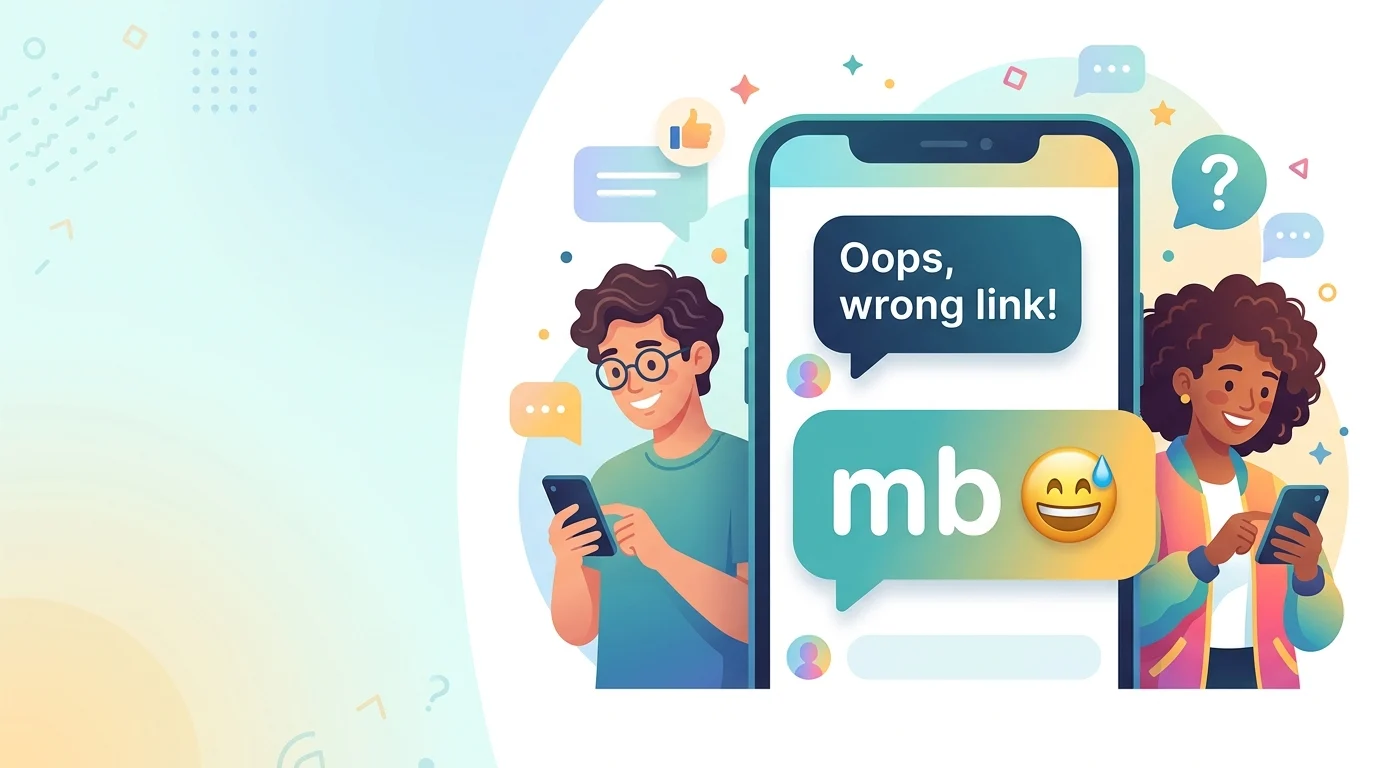
MB meaning in chat is “my bad.” People type it to say, “That was my mistake,” using just two letters. If a friend sends the wrong photo and then writes “mb,” they are saying sorry in a quick, relaxed way. You will see it in texts, group chats, game lobbies, and social media comments. Still, it can confuse people, because MB can also mean megabyte, and a few other things. That is why so many readers search for this phrase. In this guide, you will learn what mb means, how to use it, when to skip it, and how to avoid mix-ups. We will also look at real examples, common mistakes, and answers to the questions people ask most often.
Quick Answer
In most chats, mb means “my bad.” It is a casual way to admit a small mistake or say sorry without making a big deal of it. You can write it in lowercase (mb), in capital letters (MB), or with a period or emoji after it. All of these work the same way.
The phrase is common among teens and young adults, but people of all ages understand it now. If someone replies “mb” after they mixed up your name, sent a message to the wrong person, or showed up late, they just mean “my mistake, sorry.”
There is one thing to remember. MB is short for “my bad” mostly when the talk is about a mistake. If the talk is about phones, photos, or file sizes, MB almost always means megabyte. Context is the key. Look at what was said right before the message, and the meaning usually becomes clear.
What “My Bad” Actually Means
“My bad” is a casual way to take the blame. It is the same idea as saying “my fault,” “I messed up,” or “sorry about that.” The big difference is the tone. “My bad” feels light, quick, and friendly. It tells the other person, “I know I slipped, and I own it, but let’s not make this heavy.”
Think about a pickup basketball game. A player throws the ball to the wrong spot. Instead of a long speech, he holds up a hand and says, “My bad.” Everyone moves on. Chat works the same way. A fast “mb” keeps the conversation moving.
This is also why mb fits small mistakes best. It works well for a typo, a late reply, a wrong link, or a mixed-up plan. It does not work well for big problems. If you forgot a friend’s birthday, hurt someone’s feelings, or broke something valuable, two letters will feel too small. In those cases, a full sentence shows that you care.
How to Use MB Correctly in a Text or Chat
Using mb is simple, but a few small habits make it sound more natural. You can use it alone as a full reply. For example, if a friend says, “You sent me the wrong address,” you can answer, “mb.”
You can also place it before a fix. For instance: “mb, here is the right link.” This is a smooth pattern because it admits the mistake and solves it right away. People tend to like that.
You can also add a little more to make it warmer. Try “oh mb, I thought it was Friday.” This explains what went wrong without turning it into a long apology.
As for capital letters, there is no strict rule. Lowercase “mb” looks relaxed and is the most common style in casual chats. Capital “MB” can look a bit louder, and it may remind some readers of the file-size term. Most people stick with lowercase when they mean “my bad.”
Punctuation is optional. In fact, many people skip it. A single “mb” with no period looks natural in a text. Just keep it out of formal writing. School essays, job emails, and business messages need full words.
Real-Life Examples of MB in Chat
Seeing mb in action is the best way to learn it. Here are a few everyday situations.
Imagine two friends planning a movie night. One writes, “The show starts at 7, not 8.” The other answers, “oh mb, I read it wrong.” The mistake is small, and the reply is short and kind.
Now picture a group chat for a school project. Someone shares a file and then notices it is the old version. They write, “mb, wrong file. Sending the new one now.” Here, mb comes first, and the fix follows right away.
In an online game, teammates often use mb during fast rounds. A player walks into the wrong spot, and the team loses a point. He types “mb” in the team chat. It takes one second, and it keeps the mood calm.
Here is one more. A coworker texts you outside of work hours by mistake. They send a quick “mb, wrong chat.” Even in a work setting, this can be fine if the workplace is relaxed and the mistake is tiny.
Notice what all these examples share. The error is small, the tone is easy, and the message is short. That is where mb shines.
Other Meanings of MB You May See Online
Even though “my bad” is the top answer, MB can mean other things. The table below shows the most common ones and where you are likely to see them.
| Meaning | Where You See It | Example |
|---|---|---|
| My bad | Texts, game chats, social media | “mb, I sent that to the wrong person.” |
| Megabyte | Phones, apps, downloads, file sizes | “This video is 50 MB.” |
| Message board | Older forums and online communities | “I posted it on the MB last night.” |
| Manitoba | Canadian addresses and postal codes | “She lives in Winnipeg, MB.” |
The megabyte meaning is the biggest rival. A megabyte is a unit that measures digital data, like the size of a photo or a song. If someone says, “Your photo is too big, it is 12 MB,” they are not saying sorry. They are talking about file size.
The message board meaning is older and less common now. Some forum users still write “MB” to mean a message board, but you will rarely see it in modern texting. The Manitoba meaning shows up in addresses because MB is the official short form for that Canadian province.
Because these meanings are so different, mix-ups are rare once you read the full sentence.
How to Tell Which MB Someone Means
You do not need to guess. A few small clues can help you find the right meaning in seconds.
First, look at the words around it. If the message is about a mistake, a late reply, or a mix-up, MB means “my bad.” If the message includes a number, like “5 MB,” it is about file size. Numbers almost always point to megabytes.
Second, check the platform. In a game chat or a text thread with friends, “my bad” is the safest guess. In a tech setting, such as a help page, a phone settings screen, or a download message, think megabyte.
Third, look at the spelling style. People who mean “my bad” usually write it in lowercase and place it alone or at the start of a message. People who mean megabytes write the number first and use capital letters, such as “20 MB.”
Fourth, think about the flow of the talk. Did the person just do something wrong? Then it is an apology. Did they just share a file or talk about storage? Then it is a size.
If none of these clues help, simply ask. A quick “Do you mean ‘my bad’?” is polite and clears things up fast. There is no shame in checking, especially because slang changes quickly.
Where Did “My Bad” Come From?
The exact first person to say “my bad” is not known, so it is best not to pretend otherwise. What we do know is that the phrase is American slang. Many dictionaries trace it back to the 1980s, and it is often linked to playground and pickup basketball culture, where players quickly owned up to a bad pass or a missed play.
The phrase spread through the 1990s. Teen movies, TV shows, and everyday school talk helped it travel from sports courts to hallways and living rooms. By the early 2000s, many people used it without thinking twice.
Then came texting and online chat. Typing takes time, and people love shortcuts. “My bad” became “mb,” just like “be right back” became “brb” and “laughing out loud” became “lol.” The short form fit perfectly into instant messaging, game chats, and social media.
So the journey looks like this: a spoken phrase became a written phrase, and then it became a two-letter code. That path is common in internet slang. Many short chat words started as normal sayings people already used out loud.
MB vs Other Ways to Say Sorry in Chat
MB is only one of many ways to apologize in a message. Each option has a slightly different feel. This table compares the most popular ones.
| Phrase | Tone | Best Used For |
|---|---|---|
| mb | Casual and quick | Small mistakes with friends |
| sry | Casual but a bit more direct | Everyday apologies |
| oops | Light and playful | Funny or harmless slips |
| my fault | Clear and responsible | Mistakes that need a little more weight |
| I apologize | Formal and serious | Work, school, and bigger errors |
As you can see, mb sits near the lightest end of the scale. It is great when you want to keep things easy. “Sry” is similar but sounds a little more like a direct sorry. “Oops” feels playful, so it works best when nothing serious happened.
“My fault” is a good middle option. It is still simple, but it sounds more responsible than mb. And “I apologize” is the best choice when you need to sound polite and professional.
The smart move is to match your words to the size of the mistake and the person you are talking to. A friend will smile at “mb.” A boss may prefer “My mistake, I will fix it right away.”
When MB Works and When It Does Not
Tone matters more than most people think. Because text has no voice or face, short words can sound colder than we mean them to. A quick “mb” can feel friendly in one chat and careless in another.
MB works well when the mistake is small, the relationship is relaxed, and the fix is simple. It also works when everyone in the chat uses similar slang. If your friends text in short, casual bursts, “mb” will blend right in.
It works less well when the other person is upset. Imagine you were an hour late to meet a friend who waited in the cold. A lone “mb” may sound like you do not care. A better reply would be, “I am really sorry I kept you waiting. That was not fair to you.”
It also does not suit formal places. Teachers, managers, clients, and older relatives may not know the slang, or they may expect a more polite tone. When in doubt, write the full words.
A simple test can help: would you say “my bad” out loud to this person in this situation? If yes, mb is probably fine. If it would feel too casual, choose a fuller apology.
Common Mistakes People Make With MB
Even a tiny slang word can go wrong. Here are the most common slip-ups and how to avoid them.
The first mistake is using mb for serious problems. Two letters cannot carry the weight of a big mistake. If someone is truly hurt or angry, take time to write a real apology.
The second mistake is mixing it up with megabytes. If you write “mb” when you mean file size, readers may think you are apologizing. When you mean file size, write the number and use capital letters, like “8 MB.”
The third mistake is using it in formal messages. A cover letter, school report, or customer email is not the place for slang. Full phrases like “my mistake” or “my apologies” fit better.
The fourth mistake is repeating it too often. If you type “mb” after every small thing, it can feel like you are not really learning from the errors. Use it when it fits, and fix the problem when you can.
The fifth mistake is assuming everyone knows the slang. Some older adults, new English learners, and people who do not chat online much may not know it. A quick explanation can prevent confusion and make your message kinder.
Is MB Used in British English?
“My bad” started as American slang, but it has spread widely. Many young people in the United Kingdom, Canada, Australia, and other English-speaking places know it well, partly because of shared movies, music, social media, and online games.
That said, some British speakers prefer phrases like “my mistake,” “sorry about that,” or “my fault.” These feel more natural in everyday British talk, especially among older people. So if you chat with someone in the UK, mb will often be understood, but it may feel more American.
The good news is that spelling is not a problem here. MB is just two letters, so there is no difference between British and American spelling. The only real difference is how common the phrase feels in daily speech.
If you are chatting with an international friend and you are unsure, you can add a short clue. For example: “mb, my bad, I read the time wrong.” This teaches the slang gently and keeps the message clear for everyone.
Current Usage and Trends
Slang changes fast, but “mb” has proven to be a long-lasting one. It has stayed popular for many years because it is short, easy, and friendly. It also fits how people text today: fast, relaxed, and often with no punctuation.
Today, mb is common in group chats, gaming voice and text channels, comment sections, and short video platforms. Many younger users write it in lowercase and sometimes pair it with other casual words, such as “mb fr” (meaning “my bad, for real”). Others add emojis, like a face with a sheepish smile, to soften the tone.
Another trend is the use of mb in funny or exaggerated ways. Someone might joke, “mb for existing,” to poke fun at themselves. This playful use shows that the phrase has become part of everyday humor, not only apologies.
At the same time, there is no sign that mb will replace the full phrase. People still say “my bad” out loud, and they still write full sentences when needed. The short version simply gives chat users one more handy tool.
Tips for Using MB Like a Pro
Here are some simple tips to help you use mb naturally and avoid awkward moments.
Match your tone to the person. With close friends, mb is easy and warm. With strangers or older people, a full phrase may feel kinder.
Pair it with a fix when you can. A message like “mb, here is the right time” is better than “mb” alone, because it solves the problem and not just names it.
Keep it for small things. When the mistake is bigger, take a moment and write a real apology. People notice effort.
Watch the context. If numbers or files are involved, double-check that your reader will not confuse mb with megabytes. When needed, write out “my bad.”
Read the room. If the chat is serious or the other person seems upset, slow down and choose your words with care.
Finally, remember that slang is a tool and not a rule. The goal is always clear, kind communication. If a short word helps, use it. If it could cause confusion or hurt feelings, use more words.
FAQs
What does mb mean in a text message?
In a text message, mb usually means “my bad.” It is a quick way to say sorry for a small mistake. For example, if you send the wrong time and then write “mb,” you are saying, “That was my mistake.”
Is mb rude or disrespectful?
No, mb is not rude by itself. It is a friendly, casual phrase. However, it may feel too small if the mistake was serious or the other person is upset. In those cases, a longer apology is more respectful.
What is the difference between MB and “my bad”?
There is no difference in meaning. MB is just the short, typed version of “my bad.” People use it because it is faster to write, especially in texts, games, and social media comments.
Does MB always mean “my bad”?
No. MB can also mean megabyte, which measures file size. It can mean message board in some older online spaces, and it is the postal abbreviation for the Canadian province of Manitoba. The words around it usually show which meaning is right.
Can I use mb in a school or work message?
It is better not to. Formal messages call for full words, such as “my mistake” or “I apologize for the error.” You can use mb with friends or in very relaxed teams, but when you are not sure, choose the polite version.
Should I write MB in capital or lowercase letters?
Both are fine. Lowercase “mb” is more common when it means “my bad” in casual chats. Capital “MB” is more common for megabytes, so using lowercase for the apology can help avoid confusion.
Conclusion
Now you know the mb meaning in chat: it stands for “my bad,” a short and friendly way to admit a small mistake. It started as spoken American slang, then moved into texts, games, and social media, where short words are a big help. You also learned that MB can mean megabyte, message board, or Manitoba, so context matters. The best way to read it is to look at the topic, the numbers, and the platform.
When you use mb yourself, keep it for small slips and relaxed chats. Pair it with a quick fix, and choose a fuller apology when feelings are involved or the setting is formal. If you ever feel unsure about someone’s message, just ask. A little clarity is better than a big mix-up. With these tips, you can chat with confidence and keep every conversation smooth.

Hi, I’m Rubab, a content writer and meaning enthusiast with over 2 years of experience creating clear, engaging, and informative content about words, names, phrases, expressions, and their meanings. I focus on making complex or confusing meanings easy to understand through simple and reader-friendly explanations. My goal is to provide accurate, useful, and engaging content that helps readers quickly find the information they are looking for.