If you’ve seen a little “B” logo on a shampoo bottle or coffee bag, you might wonder what it means. Certified B Corporation meaning, in simple terms, is a stamp that shows a company cares about more than just making money. It proves that the business has been checked by outside experts and meets high standards for how it treats workers, communities, and the planet. People search for this term because they want to shop smarter and support businesses that do good. In this guide, you’ll learn what B Corp certification really means, how companies earn it, what changed in 2026, and how to spot the real deal.
Quick Answer
A Certified B Corporation, or B Corp, is a for-profit company that has passed a strict review by a nonprofit called B Lab. This review checks the company’s impact on workers, customers, communities, and the environment. Once a business passes, it can legally use the B Corp label to show customers it meets real, verified standards of social and environmental responsibility.
Meaning or Definition
Let’s break the term down into simple parts. “Certified” means someone independent has checked and approved it. “B Corporation” is short for “Benefit Corporation,” a phrase that points to companies trying to benefit more than just their shareholders.
So when a business becomes a Certified B Corporation, it means B Lab, a global nonprofit organization, has reviewed the company’s practices and confirmed it meets high standards. This isn’t a self-given badge. Companies cannot just print the logo on their packaging because they feel like they’re doing good. They must apply, submit proof, and pass an assessment.
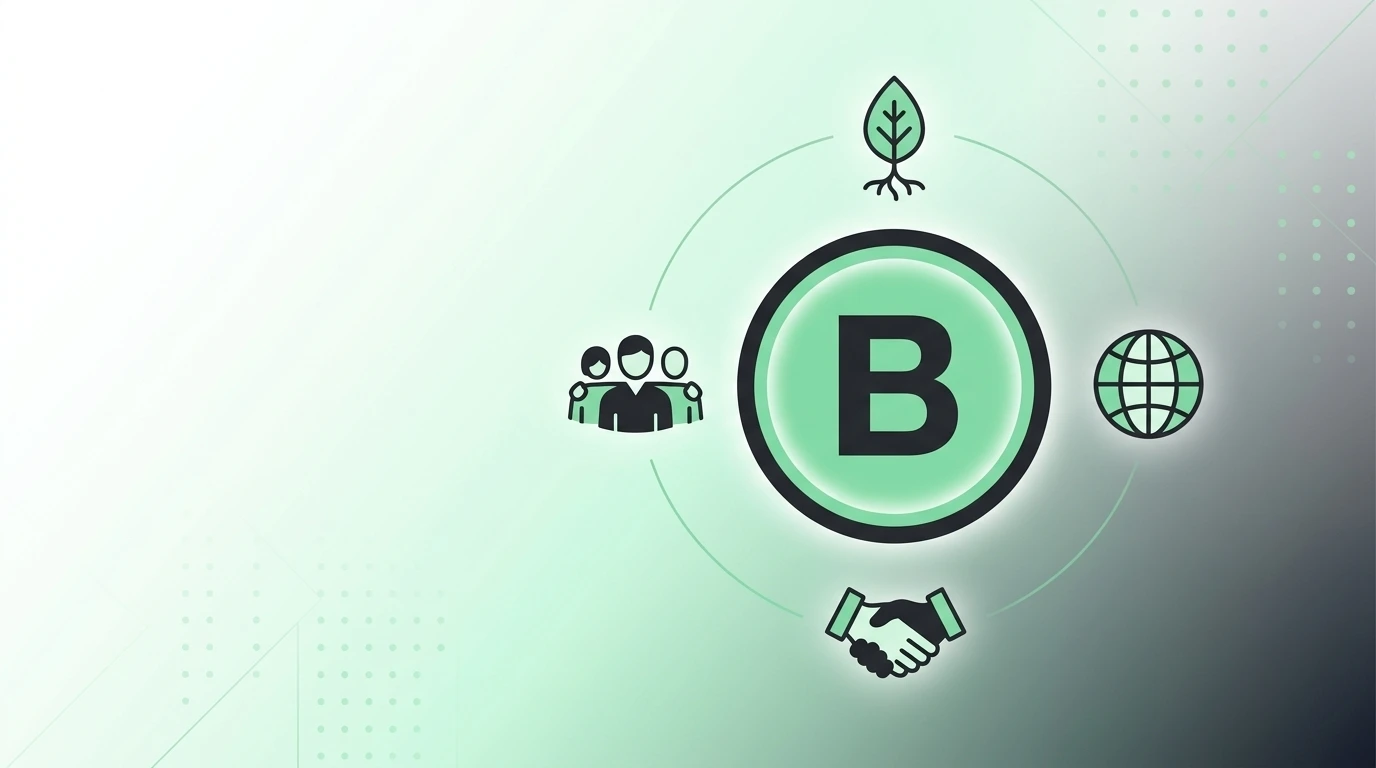
The review looks at five main areas: governance, workers, community, environment, and customers. Governance covers how the company is run and whether leaders are held accountable. Workers covers pay, benefits, and treatment of employees. Community looks at how the business treats its neighborhood, suppliers, and diversity efforts. Environment covers things like energy use and waste. Customers covers how the product or service actually helps the people who buy it.
Well-known Certified B Corporations include Patagonia, Ben & Jerry’s, Allbirds, and Seventh Generation. These companies span very different industries, which shows that B Corp certification isn’t limited to one type of business.
How Companies Earn B Corp Certification
Getting certified is not quick or easy. It usually takes months, sometimes over a year, depending on the size of the company. Here’s a simple breakdown of the steps most businesses go through.
First, the company fills out something called the B Impact Assessment. This is a detailed questionnaire that digs into daily operations, from how much water a factory uses to how workers are paid.
Second, B Lab reviews the answers and asks for supporting documents. This might include payroll records, environmental reports, or supplier contracts. Companies cannot just claim good behavior. They need paperwork to back it up.
Third, the company must legally update its governing documents. This means the business puts it in writing, often in its bylaws or articles of incorporation, that it will consider workers, communities, and the environment, not just profits, when making decisions.
Fourth, once approved, the company pays an annual certification fee. This fee is based on how much money the company makes each year, so small businesses pay much less than large corporations.
Finally, certified companies must recertify every three years. This means the process never really ends. A business cannot earn the badge once and keep it forever without proving it still deserves it.
What Changed in 2026
For nearly two decades, earning B Corp certification meant scoring at least 80 out of 200 points on the assessment, and a weak score in one area could be balanced out by a strong score somewhere else. That system has ended.
Starting with new applicants from March 2026, B Lab now requires companies to meet mandatory minimum standards across seven separate impact areas. This means a company can no longer hide a weak spot in one area, like poor environmental practices, by scoring extremely high in another area, like worker benefits. Every category now has its own floor that must be met.
Independent auditors also verify the results now, instead of relying only on self-reported answers. Climate action has become a required category with no exceptions, meaning every certifying or recertifying company must show real climate commitments backed by evidence.
The table below compares the old and new systems so you can see the difference clearly.
| Feature | Old System (Before 2026) | New System (From 2026) |
|---|---|---|
| Scoring method | One combined score, 80 out of 200 points | Mandatory minimums across seven impact areas |
| Weak spots | Could be balanced by strong scores elsewhere | Cannot be hidden or balanced out |
| Verification | Mostly self-reported | Independent third-party auditors required |
| Climate action | Optional, part of overall score | Mandatory, no exceptions |
| Improvement over time | Not required after certifying | Must show measurable progress at set milestones |
Why did B Lab make these changes? Partly because of criticism. Some well-known companies, including Dr. Bronner’s, publicly said the old point system let businesses claim the “good company” label without truly excelling everywhere. B Lab also needed to prepare for new European Union rules on sustainability labeling, which require stronger proof behind any environmental or social claim. Together, these pressures pushed B Lab toward a tougher, more transparent system.
B Corp vs Benefit Corporation: What’s the Difference
A lot of people mix these two terms up, and it’s an honest mistake since they sound so similar. But they are not the same thing.
A benefit corporation is a legal business structure. In the United States, about 40 states plus Washington, D.C. allow companies to register as a benefit corporation, much like registering as an LLC or a standard C-Corporation. This legal status requires company directors to consider workers, the environment, and the community, not only shareholders, when they make big decisions. You file this status with your state government.
A Certified B Corporation, on the other hand, is a private certification given by B Lab, a nonprofit organization. It is not a legal business structure at all. You can be a benefit corporation without ever seeking B Corp certification, and in most states, you can become a Certified B Corporation without technically being a legal benefit corporation, as long as you agree to add stakeholder language into your own governing documents.
Think of it this way: benefit corporation is like choosing a type of car, while B Corp certification is like getting that car inspected and approved by a trusted mechanic. One is a structure, and the other is a stamp of approval.
Real-Life Examples
Seeing real companies helps make this idea less abstract. Patagonia, the outdoor clothing company, became a Certified B Corporation and is famous for donating a large share of its profits to environmental causes. Ben & Jerry’s, the ice cream brand, has been certified for years and is known for social activism alongside its business.
Allbirds, the shoe company known for sustainable materials, is another certified example, showing that even newer, fast-growing brands pursue this label. Seventh Generation, which makes cleaning and personal care products, built its whole brand identity around environmental responsibility and holds B Corp status as proof.
These examples show that certification isn’t limited to small, niche companies. It spans clothing, food, footwear, and household goods, proving that businesses of many sizes and industries can pursue it.
Common Mistakes People Make
Many shoppers and even some business owners misunderstand a few key points about B Corp certification. Here are the most common mix-ups.
One common mistake is thinking “B Corp” and “benefit corporation” mean the same thing, when they are actually separate concepts, as explained above. Another mistake is assuming any company that talks about sustainability is automatically B Corp certified. Certification requires a formal application and passing an audit, so a company simply using green marketing language is not the same as being certified.
People also sometimes think the certification lasts forever once earned. In reality, companies must recertify every three years and, under the new 2026 rules, must show ongoing improvement, not just maintain the same practices. Lastly, some assume certification guarantees a perfect company with zero flaws. In truth, it means the company meets a high bar in several areas, not that it is flawless in every single decision it makes.
Current Usage and Trends
As of March 2025, there were over 9,500 Certified B Corporations spread across roughly 160 industries in more than 100 countries. This number has grown steadily since B Lab first introduced certification in 2006, showing rising interest from both companies and shoppers.
The shift toward mandatory minimums in 2026 reflects a broader trend across the business world: stricter rules on sustainability claims. The European Union’s Empowering Consumers for the Green Transition Directive is pushing companies everywhere to back up green claims with real evidence, and B Lab’s changes align with that pressure. Companies that want to keep selling products in the EU using the B Corp label must recertify under the new standards before September 27, 2026.
This trend suggests that B Corp certification will likely keep getting stricter, not easier, in the coming years. Businesses considering certification should expect a longer and more detailed process than companies faced even a few years ago.
Tips for Shoppers and Business Owners
If you’re a shopper who wants to support responsible companies, look for the actual “Certified B Corporation” logo, not just words like “eco-friendly” or “sustainable” on packaging. You can also search a company’s name on B Lab’s official directory to confirm its certification status and see its impact score breakdown.
If you’re a business owner thinking about certification, start by taking the free B Impact Assessment on B Lab’s website. This gives you a realistic picture of where your company stands before you commit time and money to the full certification process. It also helps to budget for both the application process and the ongoing annual fee, which scales with your company’s revenue.
The table below offers a quick side-by-side look at what shoppers and business owners should each focus on.
| For Shoppers | For Business Owners |
|---|---|
| Look for the official B Corp logo, not vague green language | Take the free B Impact Assessment first to gauge readiness |
| Check B Lab’s public directory to confirm certification | Budget time, since certification can take months or over a year |
| Remember certification doesn’t mean a perfect company | Prepare documentation for governance, workers, and environment |
| Understand recertification happens every three years | Plan for the annual fee, based on company revenue |
FAQs
What does it mean when a company is a Certified B Corporation?
It means an independent nonprofit called B Lab reviewed the company and confirmed it meets high standards for treating workers, communities, customers, and the environment responsibly.
Is B Corp certification the same as being a nonprofit?
No. Certified B Corporations are for-profit businesses. They still aim to earn money, but they also commit to social and environmental responsibility alongside profit.
How long does B Corp certification last?
Certification lasts three years, after which the company must go through the process again to keep its status, now with added requirements to show real improvement.
Can any business apply to become a Certified B Corporation?
Most for-profit companies can apply, but some industries face extra scrutiny, and starting in 2026, companies earning more than 1% of revenue from activities like fossil fuel production are not eligible.
Does B Corp certification cost money?
Yes. Companies pay an annual fee based on their revenue, which can range from roughly $1,000 for small businesses to tens of thousands of dollars for large corporations.
How is a B Corp different from a benefit corporation?
A benefit corporation is a legal business structure filed with a state government, while a Certified B Corporation is a private certification awarded by the nonprofit B Lab after an independent review.
Conclusion
Understanding the certified b corporation meaning helps you make better choices, If you’re shopping for products or deciding how to run your own business. At its core, this certification shows that a company has been independently checked and proven to genuinely care about workers, communities, customers, and the environment, not just profit. With the tougher 2026 standards now in place, the badge carries even more weight than before, since companies can no longer hide weak areas behind strong overall scores. If you want to support responsible businesses, look for the official logo and check B Lab’s directory before trusting any company’s claims. And if you run a business yourself, know that certification is a serious commitment, not a quick marketing trick.

Hi, I’m Rubab, a content writer and meaning enthusiast with over 2 years of experience creating clear, engaging, and informative content about words, names, phrases, expressions, and their meanings. I focus on making complex or confusing meanings easy to understand through simple and reader-friendly explanations. My goal is to provide accurate, useful, and engaging content that helps readers quickly find the information they are looking for.