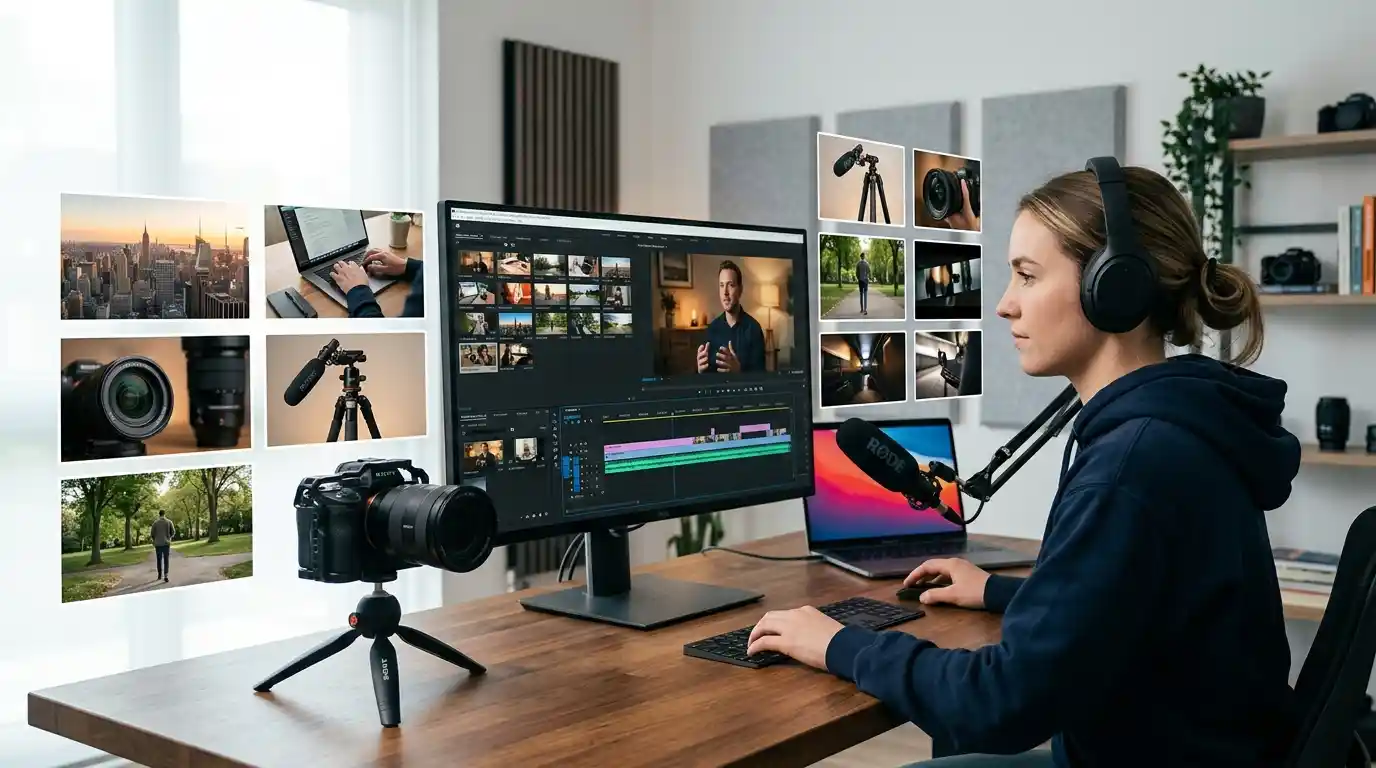
Have you ever watched a YouTube video or a news report and noticed extra footage playing while someone talks in the background?B-roll meaning refers to extra video clips that support the main footage in a film, video, or news story. It fills in visual gaps, adds context, and keeps viewers interested. If you’ve ever wondered why videos look so much better when they cut away to other scenes, b-roll is the answer.
Ever notice how the best videos never just show a talking head the whole time? That’s b-roll at work the extra footage editors sneak in to keep your eyes glued to the screen
Quick Answer
It usually doesn’t include the main speaker talking directly to the camera. Instead, it shows related scenes, objects, or actions. Think of a cooking video where someone talks about a recipe (a-roll), and then the video cuts to close-up shots of chopping vegetables or a pot boiling (b-roll). That extra footage is what keeps the video from feeling flat and boring.
Meaning or Definition
B-roll is a term used in filmmaking, television, and video editing. It means supplemental or secondary footage that gets layered into a video to support the primary shot, often called the a-roll. The a-roll is usually the main interview, speech, or scene. The b-roll is everything else that gets added around it.
For example, imagine a news reporter talking about a wildfire. The a-roll would be the reporter speaking directly into the camera. The b-roll would be shots of flames, smoke, firefighters working, or people evacuating their homes. This extra footage helps the audience understand the story better without needing to stare at the reporter’s face the whole time.
B-roll can include almost anything: nature scenes, city streets, close-ups of hands typing, product shots, or candid moments of people working. The goal is always the same. It adds depth, keeps the video visually interesting, and helps tell the story in a way that words alone cannot.
Grammar or Correct Usage
The term “b-roll” is usually written with a lowercase “b” followed by a hyphen and the word “roll.” Some style guides capitalize it as “B-roll,” especially at the start of a sentence. Both versions are widely accepted, but consistency matters within the same piece of writing.
Here’s a simple table to help you understand how to use the term correctly:
| Usage Example | Correct? | Notes |
|---|---|---|
| “We need more b-roll for this scene.” | Yes | Common usage in casual and professional settings |
| “The B-roll footage arrived late.” | Yes | Capitalized because it starts the sentence |
| “b roll” (no hyphen) | Less common | Still understood, but not the standard spelling |
| “Broll” (one word) | Incorrect | Not a recognized spelling in style guides |
As a noun, “b-roll” is almost always uncountable, similar to “footage” or “content.” You wouldn’t say “three b-rolls.” Instead, you’d say “some b-roll” or “extra b-roll footage.” As a modifier, it works well before nouns, like “b-roll shots” or “b-roll clips.”
Origin or History
The term “b-roll” comes from the early days of film editing. Back when movies were edited using physical film reels, editors worked with two rolls of film at once. The “a-roll” contained the main footage, usually the primary scene or interview. The “b-roll” contained the secondary footage that would be spliced in during editing.
This method allowed editors to smoothly cut between the two rolls without losing quality or continuity. Even though most video production today uses digital files instead of physical film, the term stuck around. It’s a great example of how old technology terms often carry over into modern digital workflows, much like how we still “dial” a phone number even though rotary phones are long gone.
News stations were some of the earliest adopters of structured b-roll usage. They needed a fast, reliable way to cut between reporters and supporting visuals during live or recorded broadcasts. Over time, the technique spread to documentaries, commercials, YouTube content, and eventually social media videos.
Real-Life Examples
Understanding b-roll becomes much easier when you see how it’s used in real situations. Here are a few common examples across different types of content:
In a business interview video, the a-roll shows the CEO answering questions. The b-roll might show employees working at their desks, the company logo on the building, or product shots on a shelf. This keeps the video from feeling like a static, boring interview.
In a wedding video, the a-roll could be the couple exchanging vows. The b-roll would include shots of guests smiling, flowers on the tables, rings being placed, and the venue decorations. These extra clips help tell the full story of the day, not just the ceremony itself.
In a travel vlog, the a-roll might be the vlogger talking about their trip to Japan. The b-roll would show cherry blossoms, busy streets, food stalls, and train stations. This gives viewers a visual escape and makes the video feel more immersive.
In a real estate listing video, the a-roll could be the agent describing the home’s features. The b-roll would show close-ups of the kitchen counters, the backyard, natural lighting through windows, and neighborhood streets.
Current Usage or Trends
B-roll has become even more important with the rise of short-form content on platforms like TikTok, Instagram Reels, and YouTube Shorts. Fast-paced editing styles rely heavily on quick b-roll cuts to keep viewers engaged for those crucial first few seconds.
Content creators now often plan their b-roll shot lists before filming even begins. This is a shift from older production methods, where b-roll was sometimes an afterthought captured only if there was extra time. Today, many creators treat b-roll as equally important as the main footage.
Stock footage websites have also made b-roll more accessible than ever. Creators who don’t have time to film their own supplemental footage can now purchase or download pre-made clips. This has lowered the barrier for smaller creators and businesses to produce polished, professional-looking videos.
Another growing trend is using b-roll to boost search engine optimization for video content. Platforms like YouTube reward videos that keep viewers watching longer. Well-placed b-roll increases watch time by making videos more visually engaging, which can improve how often a video gets recommended.
Tips or Best Practices
Getting good b-roll takes a bit of planning, but it doesn’t have to be complicated. Here are some practical tips that professional editors and creators rely on:
| Tip | Why It Helps |
|---|---|
| Shoot more than you think you need | Gives editing flexibility later |
| Vary your shot angles and distances | Keeps footage visually interesting |
| Capture natural movement | Static shots can feel stiff or lifeless |
| Match b-roll to the audio topic | Keeps the story clear and connected |
| Use good lighting | Poor lighting makes footage unusable |
| Keep clips at least 5-10 seconds long | Gives editors room to trim as needed |
Always think about what visuals would naturally support what’s being said. If someone is talking about baking bread, b-roll of flour, dough, and an oven makes sense. Random unrelated clips can confuse viewers and weaken the story.
It also helps to capture b-roll from multiple angles of the same action. This gives editors more options during the editing process and prevents the footage from feeling repetitive if it needs to be used more than once.
Lastly, always label and organize b-roll files right after filming. Searching through hundreds of unlabeled clips later wastes valuable editing time.
Common Mistakes
Many beginners make a few common errors when working with b-roll. One frequent mistake is capturing footage that doesn’t relate to the main topic. Random clips that don’t support the story can confuse viewers instead of helping them.
Another mistake is not shooting enough variety. If all your b-roll looks the same, the video can feel repetitive even if the content is different. Mixing close-ups, wide shots, and medium shots creates a much richer visual experience.
Some creators also forget to capture b-roll with proper lighting, assuming they can fix it later in editing. While minor adjustments are possible, poorly lit footage often looks unprofessional no matter how much editing is applied.
Finally, using b-roll for too long without cutting back to the main subject can make viewers feel disconnected from the speaker or story. Balance is key.
FAQs
What is the difference between a-roll and b-roll?
A-roll is the main footage, like an interview or the primary scene. B-roll is the supporting footage that adds context, visuals, and interest around the main content.
Do you need special equipment to shoot b-roll?
No. While professional cameras help, many creators shoot great b-roll using smartphones. Good lighting and steady shots matter more than expensive gear.
Can b-roll include sound?
Sometimes. Ambient sound, like traffic noise or nature sounds, can be kept for realism. However, the main audio usually still comes from the a-roll narration or interview.
How much b-roll should a video have?
There’s no fixed rule, but many editors aim for a mix where b-roll covers a good portion of the video, especially during storytelling or explanation segments, while a-roll drives the main message.
Is stock footage the same as b-roll?
Stock footage can be used as b-roll, but not all b-roll comes from stock sources. Many creators film their own original b-roll to keep content authentic and unique.
Why is b-roll important for YouTube videos?
B-roll keeps viewers engaged, increases watch time, and helps explain topics visually. This can improve audience retention, which platforms like YouTube often favor when recommending content.
Conclusion
B-roll meaning comes down to one simple idea: it’s the extra footage that makes videos feel complete, engaging, and professional.
From wedding videos to YouTube tutorials, b-roll plays a huge role in helping stories come to life visually.
If you’re a beginner creator or just curious about video terminology, understanding b-roll gives you a better appreciation for the work behind every polished video you watch.
If you’re planning your next video project, remember to shoot plenty of varied, relevant b-roll.
It might just be the difference between a video that feels flat and one that truly captures your audience’s attention.

Hi, I’m Mishi, a content writer and researcher specializing in meanings, interpretations, and informative explanations. With 2 years of experience creating clear, engaging, and SEO-friendly content, I help readers understand the meanings behind words, phrases, names, symbols, numbers, and everyday expressions.
My goal is to provide simple, accurate, and easy-to-understand information that answers readers’ questions while making every topic interesting and useful.